 EN
EN


Three Countries, Three Different Conversations
The second half of 2026 puts die casting on three different stages. Colombia, Mexico, and Turkey are not interchangeable markets, and treating them that way is the fastest way to have a busy-looking calendar that produces no real business. Each one has a distinct industrial base, a distinct set of buyers, and a distinct reason to be worth the trip.
For a supplier of cold chamber and hot chamber presses, furnaces, and peripheral handling equipment, the interesting part is not that these are big shows. It is that each one reaches a different slice of the casting world, and the conversations at each will be shaped by how that local industry is growing and what it is investing in right now.
Three stops on the calendar inside a single half-year is a statement in itself. It signals that these markets are seen as worth the travel, and it gives buyers in each country a chance to see the equipment and the people behind it without crossing an ocean.
Colombia and Mexico: The Americas Leg
Colombia and Mexico both have manufacturing sectors that depend on cast components, but they lean differently. Mexico is a large production base, with a deep automotive and appliance industry that runs die castings at volume and has an established supplier chain. The buyers there tend to be technical and cost-aware, and they are often looking to upgrade or replace machines that have run for a long time.
Colombia is a smaller and more varied market. There is a real appetite for cast components in construction hardware, food processing equipment, and light industrial machinery, and the buyers are often producer-distributors who handle a range of parts. The conversation there is less about the highest throughput and more about flexibility, support, and being able to source a whole line or a single machine without a lot of back and forth.
Both markets share one trait that matters for a supplier. The buyers value a partner who can support the machine after delivery, with spares, commissioning help, and training, because that is what keeps a small or mid-size plant running. A lower price at the point of sale stops meaning much if the line sits idle waiting on a part.
Turkey: ANKIROS 2026 at a Glance
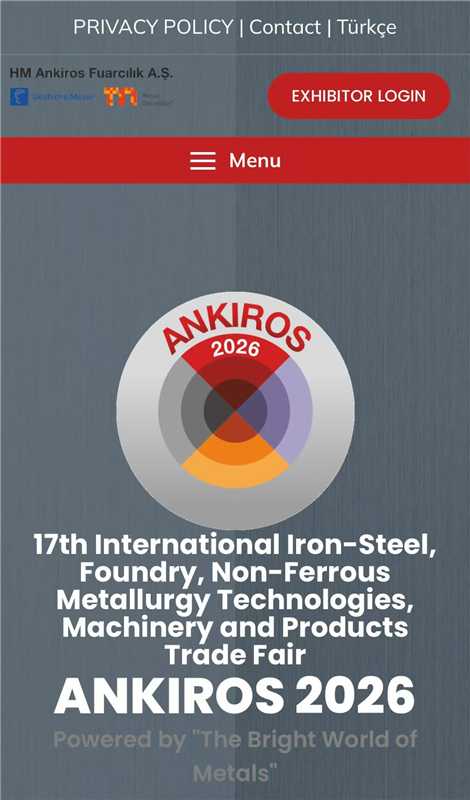
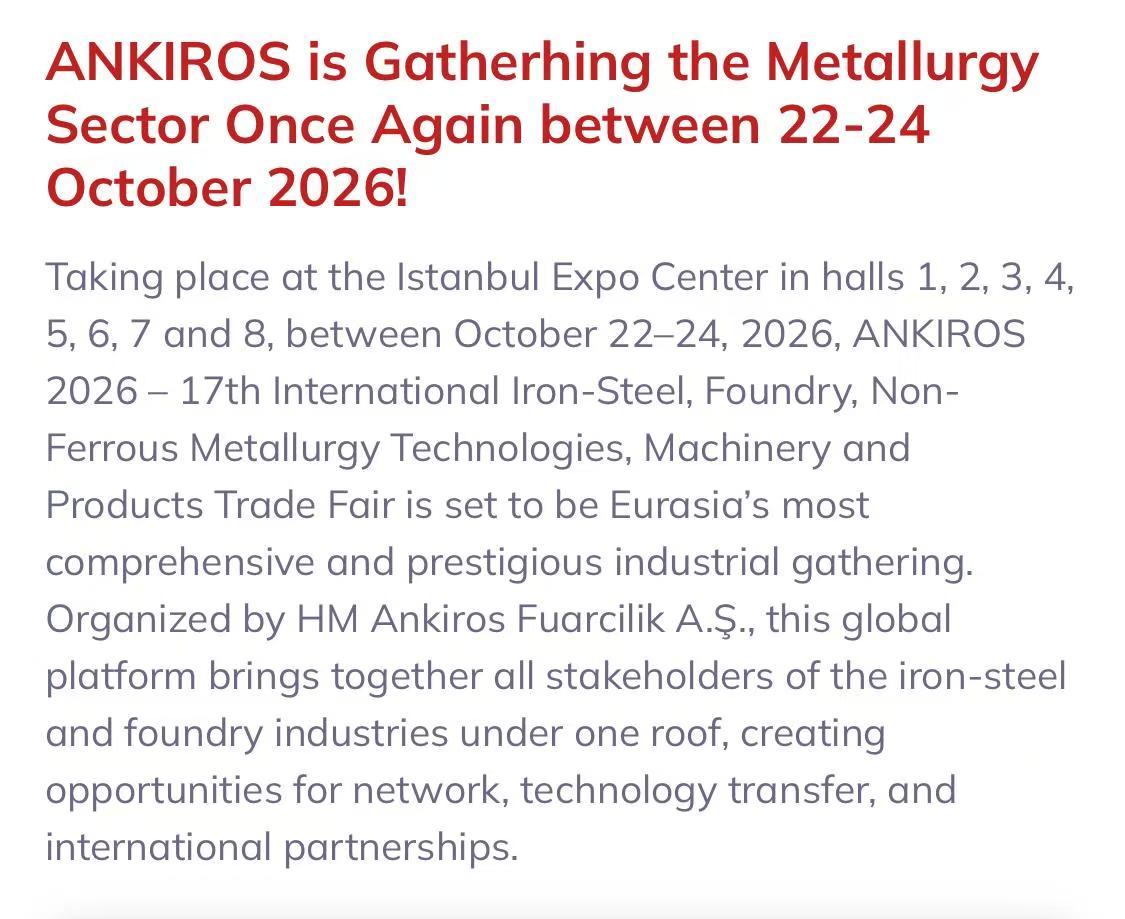
The Turkey leg is ANKIROS 2026, the 17th International Iron-Steel, Foundry, Non-Ferrous Metallurgy Technologies, Machinery and Products Trade Fair. It runs at the Istanbul Expo Center from October 22 to 24, taking up halls one through eight, a setup that tells you straight away how large the event is. The show is organized by HM Ankiros Fuarcilik and positions itself as one of Eurasia's more comprehensive industrial gatherings, under the banner of the bright world of metals.
For die casting, ANKIROS is a good fit precisely because it is not limited to one process. A foundry and metallurgy show pulls in the whole metal working chain, casting, melting, machinery, and the products that come out of them. That means a supplier of both cold chamber and hot chamber machines, along with the furnaces and the handling gear, is talking to an audience that already understands what a line includes, without needing a basic introduction.
The timing is also practical. October in Istanbul puts the show alongside buyers from a wide region, and it gives a chance to pick up on what the foundry sector is investing in as it modernizes.
Walking the ANKIROS halls gives a buyer a sense of the whole supply chain in one place, from melting equipment and foundry machinery to the finished cast products, along with the service providers that support them. For a producer that sources die casting equipment and the peripheral gear together, that breadth means the comparison shopping happens quickly, and the booth becomes a place to settle the details rather than to start from scratch.
Why Face-to-Face Still Moves Die Casting Business
It is fair to ask why anyone still flies to a trade show when a video call can cover the technical details. The answer is that die casting equipment is bought on confidence, not on a spec sheet. A buyer wants to see the machine, watch the build quality, and read the data in person before committing to something that will sit on the plant floor for years.
There is also the part that does not show up in a brochure. Price and lead time are easy to compare. Service philosophy, responsiveness, and how a supplier handles a problem are only visible in a conversation. And a booth is one of the few places where a buyer can talk to the same engineers who build the machine, instead of to a sales filter.
The useful visits are the prepared ones. A buyer who brings a part drawing, or at least a clear idea of the alloy, the part size, and the expected volume, walks away with a much more concrete answer than one who is still deciding. The same holds for a supplier. The more specific the question at the booth, the sharper the proposal that follows.
For a supplier, the benefit is symmetrical. Meeting the market face to face is how the product range gets validated and how new requirements surface early, before they become a missed sale.
An Open Invitation
Taken together, the three stops cover a wide stretch of the casting world in a single season, from the Americas to the meeting point of Europe and Asia. That spread matters for buyers who source regionally, because it shortens the distance between a question and a machine that answers it.
Each of these shows is a chance to see the equipment up close and to talk through a specific requirement with people who build the machines. For anyone planning a die casting line, or looking to modernize an existing one in the next year, the second half of 2026 is a good window to do that in person. The Zhenli booth will be there, staffed by a team that can talk through die, automation, and commissioning questions on the spot. Visitors are welcome to stop by, bring a part drawing, and talk through the setup. With a track record that spans over two decades in the industry and a factory that already ships to dozens of countries, the main thing the booth has to offer is a straight answer to a practical question, and that is worth the walk across the hall.