 EN
EN



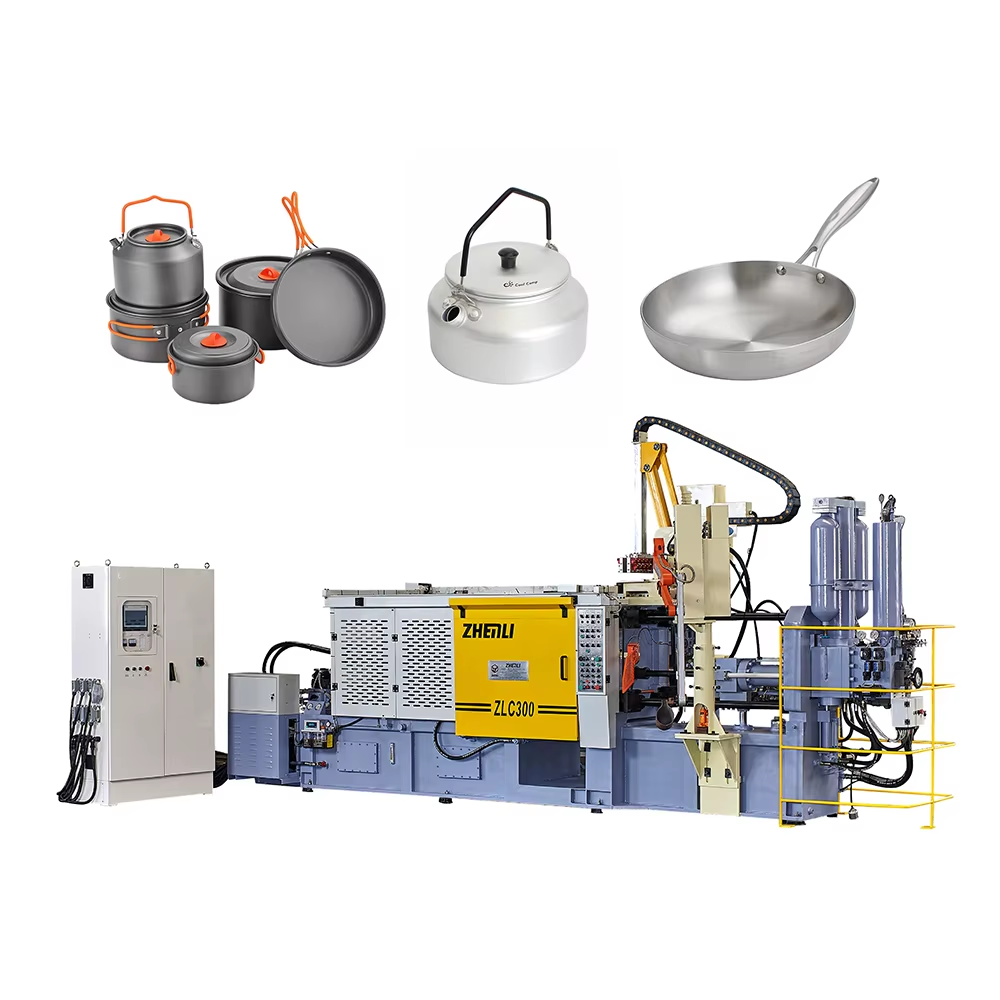
The industry is shifting — and fast
The metal casting machinery market is in the middle of a transformation that's happening faster than many in the industry anticipated. The global die casting machinery market was valued at roughly $3.6 billion in 2025 and is projected to reach about $5.7 billion by 2032, a compound annual growth rate around 6.7%. That growth isn't just about more machines — it's about different machines, with different capabilities and different economics.
What's driving this shift? A convergence of pressures: energy costs, labor availability, quality expectations, and sustainability mandates. Foundries are upgrading from hydraulically intensive legacy equipment to servo-driven and hybrid die casting machines that reduce energy use and improve process consistency. The trend lines are clear, and they're reshaping what a modern metal casting operation looks like.
Servo drives and hybrid power: the energy revolution
Hydraulic systems have dominated die casting for decades. They're powerful, reliable, and well-understood. But they're also inefficient — hydraulic pumps run continuously, wasting energy during idle periods and generating heat that needs to be removed.
Servo-driven machines change that equation. Instead of a constant-speed pump running all the time, servo systems use variable-speed motors that only deliver power when it's needed. The energy savings can be substantial — 30% to 50% reduction in power consumption is realistic for many applications. And because servo systems generate less heat, the hydraulic oil lasts longer and cooling requirements are reduced.
Hybrid machines take this further, combining servo-driven clamping with hydraulic injection, or vice versa. The trend is moving toward full electrification of key functions, with foundry-grade servo cylinders and linear actuators replacing traditional hydraulic components.
The market reflects this shift. The global die casting automation equipment market, which includes servo and control systems, is projected to grow from about $799 million in 2025 to $995 million in 2032. That's a compound annual growth rate that outpaces the overall machinery market, indicating that automation and servo technology are becoming differentiators, not just options.
IoT and data: the connected foundry
The foundry floor has historically been a noisy, hot, and surprisingly analog environment. That's changing. Industrial IoT platforms are increasingly being integrated with die casting machines, enabling real-time production monitoring and optimization. Sensors on the machine — measuring temperature, pressure, position, and velocity — feed data into systems that can detect anomalies before they become defects.
The practical impact is significant. Instead of discovering that a shot went bad when the part comes out of the die, operators can see the deviation happening in real time and adjust before the next shot. For high-volume production, that kind of closed-loop control can reduce scrap rates substantially.
Advanced control systems now integrate machine learning algorithms with predictive analytics, enabling dynamic process adjustments that minimize scrap and accelerate cycle times. The die casting landscape stands at the cusp of profound transformation as disruptive technologies and advanced manufacturing paradigms converge to reshape production efficiency and quality benchmarks.
This connectivity extends beyond the individual machine. Modern die casting machines are increasingly connected with MES systems and industrial IoT platforms. Production data flows up to the enterprise level, providing visibility into overall equipment effectiveness, maintenance needs, and production scheduling. For operations running multiple machines across multiple shifts, that visibility is invaluable.
Automation and robotics: filling the labor gap
Labor availability is a growing concern in the die casting industry. The work is physically demanding, the environment is hot, and skilled operators are getting harder to find. Automation is filling that gap.
Robotic tending cells are becoming standard in modern die casting operations. A typical cell includes a robot that extracts freshly cast parts, checks pick validity, quenches them, and transfers them to a trim press — all while minimizing manual intervention. These systems can run unattended for extended periods, allowing a single operator to oversee multiple machines.
The automation depth is becoming the defining differentiator between competitive and struggling operations. Fully automatic die casting machines, which handle everything from ladling to part extraction to die spraying, are seeing strong demand growth. The market is being reshaped by integrated automation, data-driven control, and flexible cell design.
For shop floor managers, this trend means rethinking staffing models. The role of the operator is shifting from manual machine control to system monitoring and exception handling. That requires different skills, different training, and a different mindset.
| Technology Trend | Key Benefit | Adoption Status |
|---|---|---|
| Servo drives | 30-50% energy reduction | Rapidly growing |
| IoT connectivity | Real-time process control | Early majority |
| Robotic tending | Reduced labor dependence | Growing rapidly |
| Hybrid machines | Balance of power and efficiency | Emerging |
| AI/ML process control | Predictive quality management | Early adoption |
AI and machine learning: the next frontier
Artificial intelligence is increasingly influencing die casting machinery by improving process control, maintenance planning, quality assurance, and production optimization. This isn't science fiction — it's happening in foundries today.
Machine learning algorithms can analyze historical production data to identify the optimal process parameters for a given part geometry. They can detect patterns in sensor data that precede equipment failures, enabling predictive maintenance that avoids unplanned downtime. They can even adjust process parameters in real time based on variations in incoming material or ambient conditions.
The challenge is implementation. AI systems require data — lots of it — and that data needs to be clean, structured, and accessible. For older machines without sensors or connectivity, retrofitting is the first step. But for new machines, AI-ready control systems are becoming a standard feature.
A real-world automation upgrade
A medium-sized foundry running a mix of aluminum and zinc parts was struggling with quality consistency across shifts. The day shift operator had decades of experience and could "feel" when the machine needed adjustment. The night shift operator was newer and produced more scrap. The difference in yield between shifts was running about 5%.
The solution wasn't more training — it was automation. The foundry retrofitted its existing machines with sensor packages and a centralized control system that monitored key parameters and provided real-time feedback to operators. The system included a simple dashboard that showed green/yellow/red status for each critical variable. If a parameter drifted out of spec, the system alerted the operator before bad parts were produced.
The result? Scrap rates equalized across shifts. The night shift operator, with less experience, could now produce parts at the same quality level as the day shift veteran. The investment paid for itself in less than a year through reduced scrap and rework.
What this means for equipment decisions
The trends in metal casting machinery point to a future where machines are smarter, more efficient, and more connected than ever before. For anyone specifying new equipment, that means looking beyond the basic specifications — clamping force, shot size, cycle time — and considering the broader ecosystem:
Does the machine support servo drives or hybrid power?
Can it connect to existing MES or IoT platforms?
Is it compatible with robotic tending and automation cells?
Does the control system support data logging and analysis for process optimization?
The answers to these questions will determine not just the machine's performance today, but its relevance five or ten years from now. In a market where technology is evolving rapidly, buying a machine that can't adapt is a decision that carries long-term consequences.