 EN
EN



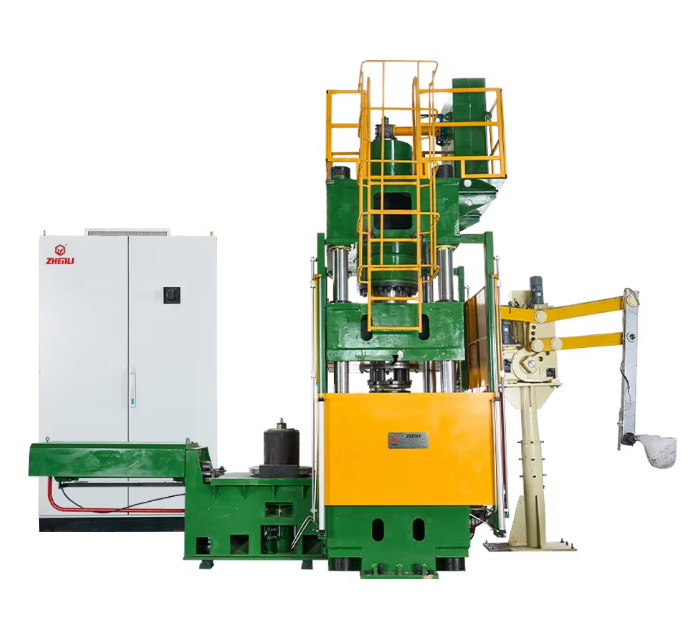
Zinc casting seems straightforward on paper. Low melting point, great fluidity, fast cycles. But anyone who has spent time on a zinc production floor knows the real challenge: temperature consistency. A shift of just 10°C in melt temperature can change linear shrinkage by 0.025% to 0.035%. That does not sound like much until a connector housing comes out 0.1 mm undersize and refuses to seat properly in the final assembly.
Zinc die casting machines paired with automatic ladling systems solve this at the source. Instead of relying on an operator with a hand ladle—pouring different volumes at varying intervals with unpredictable temperature drop—an automated system delivers the same shot weight, at the same temperature, every single cycle.
What Automatic Ladling Actually Changes
Manual charging on a zinc line typically produces 10 to 15 parts per hour, with temperature fluctuations reaching ±15°C during transfer. A worker scoops molten zinc from the furnace, carries it across the shop floor, and pours it into the shot sleeve. By the time the metal reaches the injection chamber, it has already started cooling. That temperature loss changes viscosity, which changes how the metal fills thin-walled sections.
An automated ladling system changes the math entirely. Transfer temperature loss is held within ±3°C. Feeding quantity accuracy lands at ±2%. The robotic arm cycles with timing stability of ±0.5 seconds. Every shot starts from the same thermal baseline. Every casting sees the same melt behavior.
A Case from a Connector Plant in Southern China
A contract manufacturer running 12 zinc die casting machines for electronics connectors had a recurring issue: parts from cavity four on an eight-cavity mold consistently showed cold flow marks. The shop assumed the mold was damaged. They sent it out for rework twice. Nothing changed.
After a week of data logging, the real culprit surfaced. The operator feeding the machine was spending an extra 4 to 5 seconds on the walk back from the furnace during night shifts—the ladle was cooling down while he was chatting with the next station operator. Day shift had no problem because the walk path was clear. Night shift had pallets stacked in the aisle. Temperature loss from the extra seconds changed the viscosity enough that cavity four, the furthest from the gate, was starving.
An automatic ladling system eliminated the human variable entirely. Feed quantity, temperature stability, and timing became machine-controlled constants. Cold flow defects dropped from 5.8% to under 1% across all shifts within two weeks.
Hot Chamber Setup Makes Ladling Different
Hot chamber die casting machines for zinc alloys integrate the injection cylinder directly into the molten metal bath. The gooseneck and plunger sit submerged at around 385°C to 420°C. That design already reduces oxidation and thermal loss compared to cold chamber systems. But even with the gooseneck setup, the ladling method from furnace to injection system still matters.
In a hot chamber machine, the metal is always ready—the furnace is attached by the gooseneck feed system. But the automated ladle or dosing system that fills the gooseneck needs precision. Overfill causes spillage and dross formation. Underfill starves the shot. Consistency in the feeding step translates directly to consistency in the casting step.
Cold Chamber vs. Hot Chamber Feeding: How Ladling Fits
The role of automatic ladling varies between machine types because the architectures are fundamentally different.
|
Aspect
|
Cold Chamber Die Casting
|
Hot Chamber Die Casting
|
|---|---|---|
|
Where ladling happens
|
Ladle transfers from separate furnace to injection sleeve
|
Ladle or dosing system supplies metal to gooseneck intake
|
|
Critical control variable
|
Shot weight and temperature at transfer
|
Fill volume consistency to gooseneck
|
|
Risk of temperature loss
|
High (metal sits in sleeve before injection)
|
Lower (system stays submerged)
|
|
Common defect from poor ladling
|
Cold shuts from temperature drop
|
Dross and inconsistent fill volume
|
For cold chamber machines, the ladling system fights temperature loss during the transfer gap. For hot chamber machines, the fight is about volume precision and avoiding dross. Both need automation, but for different reasons.
What the Industry Data Says
The global die casting machinery market was valued at USD 3.62 billion in 2025 and is projected to reach USD 6.31 billion by 2032, growing at a CAGR of 8.24%. A significant driver of this growth is the adoption of automated auxiliary systems, including ladling, that reduce labor dependency and improve repeatability.
Industry publications note that automated ladling systems are a key upgrade over manual feeding, delivering 3 to 5 times higher efficiency and feeding quantity accuracy within ±2%. For high-volume zinc production running 50,000 to 200,000 parts per month, that level of consistency is not optional. It is the difference between a profitable line and a scrap-heavy money pit.
Where Automatic Ladling Does Not Replace Process Discipline
Automated ladling eliminates human variability, but it does not fix bad process design. A system that pours the wrong shot weight for the part geometry will still produce rejects, even if every pour is exactly the same wrong weight. Similarly, if the die temperature is not maintained properly, consistent melt temperature alone will not prevent cold shuts. Automation amplifies whatever process it serves. Good process plus automation equals great results. Bad process plus automation just produces bad parts faster.
Zhenli Machinery supplies die casting solutions across all three global product lines, and its zinc-focused hot chamber machines are built around the understanding that feeding consistency is not a luxury—it is a requirement for tight-tolerance production.